Oxford English Dictionary AI Quotation Finder
Designing around model latency and unverified AI results
Two important constraints
The additional quotations found by the AI had not been through the same editorial process. They could be useful for research, but we needed to make their different status completely clear.
The EarlyPrint corpus also covers a specific date range, so users needed to understand both where the quotations came from and the limits of the available material.
Other AI assistants across the platform used a modal window. Early discussions also considered placing the Quotation Finder in a separate window or on a separate page.
However, this would have interrupted the user's research. A modal could leave them waiting with no useful action to take, while a separate page would remove the results from the word sense that had generated the query.
Keeping the tool inside the entry
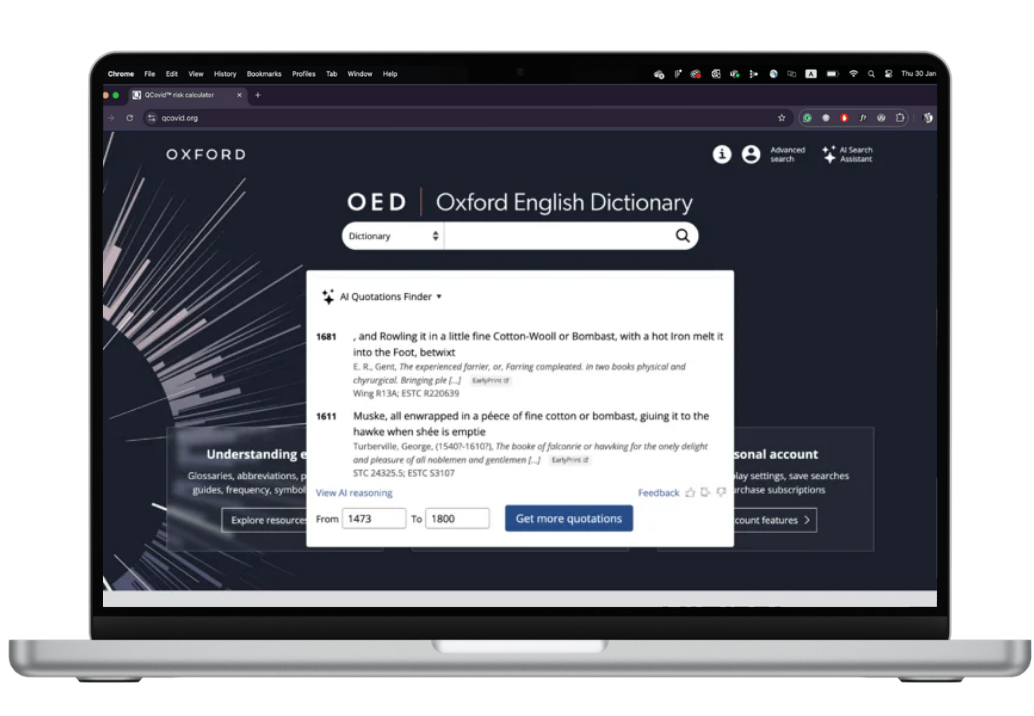
I proposed placing the Quotation Finder directly within the dictionary entry, immediately after the editor-verified quotations for the relevant word sense.
The tool is collapsed by default. When needed, the user can open it, adjust the available settings and start the search. While the model is working, they can continue reading and researching on the same page, then return to the results when they are ready.
This broke with the existing modal pattern, but kept the AI feature connected to its context and avoided making the wait the main part of the experience.
Making the limitations visible
The AI-generated results are visually separated from the verified OED quotations. The interface identifies EarlyPrint as the source and explains that the quotations have not been verified by OED editors.
During usability testing of the prototype, we found that this message was not prominent enough. We moved it into the platform's standard red warning panel so that users were less likely to miss it. The warning can be dismissed once the distinction is understood, rather than taking up space every time the feature is used.
Each quotation also includes access to the AI reasoning behind its selection. This helps researchers understand why the model considered it relevant, assess the quality of the match and decide whether to use or reject it.
Outcome
The embedded approach was accepted by the team and the AI Quotation Finder is now live in production.
The model's processing time has not disappeared, but the interface works around it: researchers can continue with their task while the search runs. At the same time, the source, editorial status and reasoning behind the results remain visible.
The project reinforced a principle I use when designing AI products: consistency is useful only when the existing pattern supports the way the technology actually behaves.
- The results were not editor-verified
The additional quotations found by the AI had not been through the same editorial process. They could be useful for research, but we needed to make their different status completely clear.
The EarlyPrint corpus also covers a specific date range, so users needed to understand both where the quotations came from and the limits of the available material.
- The search could take up to ten minutes
Other AI assistants across the platform used a modal window. Early discussions also considered placing the Quotation Finder in a separate window or on a separate page.
However, this would have interrupted the user's research. A modal could leave them waiting with no useful action to take, while a separate page would remove the results from the word sense that had generated the query.
Keeping the tool inside the entry
I proposed placing the Quotation Finder directly within the dictionary entry, immediately after the editor-verified quotations for the relevant word sense.
The tool is collapsed by default. When needed, the user can open it, adjust the available settings and start the search. While the model is working, they can continue reading and researching on the same page, then return to the results when they are ready.
This broke with the existing modal pattern, but kept the AI feature connected to its context and avoided making the wait the main part of the experience.
Making the limitations visible
The AI-generated results are visually separated from the verified OED quotations. The interface identifies EarlyPrint as the source and explains that the quotations have not been verified by OED editors.
During usability testing of the prototype, we found that this message was not prominent enough. We moved it into the platform's standard red warning panel so that users were less likely to miss it. The warning can be dismissed once the distinction is understood, rather than taking up space every time the feature is used.
Each quotation also includes access to the AI reasoning behind its selection. This helps researchers understand why the model considered it relevant, assess the quality of the match and decide whether to use or reject it.
Outcome
The embedded approach was accepted by the team and the AI Quotation Finder is now live in production.
The model's processing time has not disappeared, but the interface works around it: researchers can continue with their task while the search runs. At the same time, the source, editorial status and reasoning behind the results remain visible.
The project reinforced a principle I use when designing AI products: consistency is useful only when the existing pattern supports the way the technology actually behaves.